
Project Overview
When a Hamilton homeowner contacted Birnie Plumbing & Drains, they were frustrated by a sewer problem that seemed to return no matter what they did.
For years, the home’s drains would begin slowing down unexpectedly. Toilets occasionally gurgled, the basement floor drain would back up during periods of heavy water usage, and every year or two the homeowner found themselves calling for drain cleaning again.
Each cleaning restored flow temporarily, but the relief never lasted.
The homeowner was concerned they might be facing a major excavation project, potentially involving their landscaping, driveway, and a significant repair bill.
To determine the cause of the recurring problem, our team performed a professional sewer camera inspection.
What we discovered is a common issue in many older Hamilton homes.
The Problem
The home was built in the 1950s and still relied on its original clay sewer service.
While clay sewer pipe was commonly installed throughout Southern Ontario for decades, many of these systems are now reaching the end of their useful life. Over time, joints can separate, pipes can shift slightly, and tree roots can find their way inside.
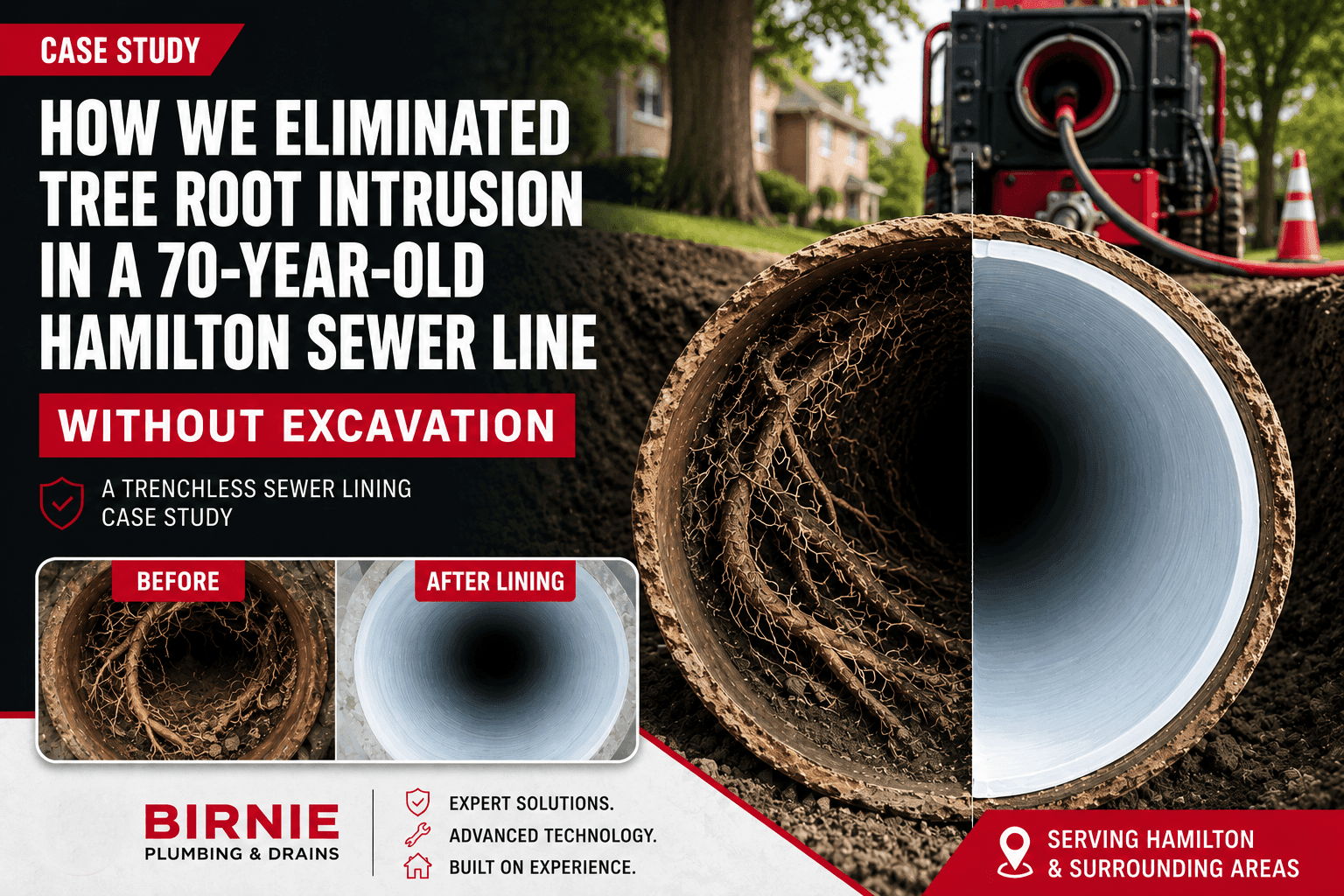
During the camera inspection, we identified significant root intrusion throughout a section of the sewer line.
The roots had entered through aging pipe joints and had gradually expanded inside the sewer system over many years.
As the roots continued to grow, they began trapping paper products, grease, debris, and other materials moving through the pipe. This created recurring restrictions that explained why the homeowner’s drainage problems kept returning.
The inspection revealed:
- Heavy tree root intrusion
- Aging clay sewer pipe
- Separated pipe joints
- Multiple areas of root growth
- Flow restrictions throughout the affected section
- Evidence of long-term infiltration
Fortunately, while the pipe was deteriorating, it had not collapsed.
This distinction would prove important when determining the best repair option.
Understanding the Homeowner’s Options
After reviewing the camera footage with the homeowner, we discussed several possible solutions.
Option 1: Root Removal Only
The first option involved mechanically removing the roots and restoring flow through professional drain cleaning.
While this would solve the immediate blockage, it would not address the underlying problem.
The roots had entered through damaged joints, meaning they would almost certainly return over time.
This option offered the lowest upfront investment but was unlikely to provide a permanent solution.
Option 2: Traditional Sewer Replacement
The second option involved excavating the affected sewer line and replacing the damaged clay pipe with modern PVC sewer pipe.
This approach would permanently remove the damaged section and eliminate the root intrusion problem.
However, excavation would involve significantly more disruption to the property and require restoration once the work was complete.
Option 3: Trenchless Sewer Lining
The third option involved rehabilitating the existing sewer line using trenchless sewer lining technology.
Because the pipe still maintained enough structural integrity and had not collapsed, the sewer line qualified for a trenchless repair.
This option would allow the homeowner to avoid major excavation while still addressing the underlying cause of the problem.
After reviewing the advantages and limitations of each approach, the homeowner elected to proceed with trenchless sewer lining.
Preparing the Sewer Line for Lining
Before a sewer liner can be installed, the pipe must be properly cleaned and prepared.
This step is critical because the liner needs to bond correctly and create a smooth, continuous pipe inside the existing sewer system.
Our team began by removing the extensive root growth throughout the affected section of sewer.
The line was then thoroughly cleaned to remove debris, buildup, and any remaining root material.
Once cleaning was complete, another detailed camera inspection was performed to verify the condition of the pipe and ensure it was suitable for lining.
Measurements were taken to confirm the proper liner size and installation requirements.
At this stage, the homeowner could clearly see the difference between the heavily root-infested pipe and the cleaned sewer line that was ready for rehabilitation.
Installing the Trenchless Sewer Liner
With the sewer line fully prepared, the lining process could begin.
A specialized resin-saturated liner was inserted into the existing clay sewer pipe and carefully positioned throughout the damaged section.
Using professional trenchless installation equipment, the liner was expanded against the interior walls of the original sewer pipe.
As the liner cured, it formed a new seamless pipe inside the existing sewer system.
Unlike traditional clay pipe joints, which can separate over time and allow roots to enter, the finished liner creates a continuous barrier throughout the rehabilitated section.
The newly lined sewer now offered several important benefits:
- Sealed root entry points
- Eliminated separated joints
- Improved flow characteristics
- Reduced future maintenance requirements
- Extended the service life of the sewer system
- Avoided extensive excavation
Most importantly, the homeowner was able to achieve a long-term solution without digging up large sections of their property.
The Final Inspection
Once the lining process was complete, a final sewer camera inspection was performed.
The difference was dramatic.
Where roots had previously occupied portions of the pipe, the camera now showed a smooth, continuous interior surface designed to promote proper wastewater flow.
The inspection confirmed:
- Root intrusion had been eliminated
- Damaged joints were sealed
- Flow restrictions were removed
- The liner was properly installed
- The sewer line was functioning correctly
The homeowner was provided with footage of the completed installation and could see the results firsthand.
The Result
Following the project, the homeowner immediately noticed improved drainage performance throughout the home.
The recurring symptoms that had been causing frustration for years were eliminated.
No more slow drains.
No more gurgling toilets.
No more concerns about roots returning through aging clay pipe joints.
Most importantly, the homeowner avoided a major excavation project while still receiving a long-term repair solution.
Why Tree Roots Are Such a Common Problem in Hamilton
Many Hamilton neighbourhoods contain homes built decades ago with original clay sewer services.
As these systems age, roots naturally seek out moisture and often enter through small gaps, cracks, and separated joints.
Once inside, roots continue growing and can create significant flow restrictions.
Common warning signs include:
- Recurring drain backups
- Slow drains throughout the home
- Gurgling toilets
- Basement floor drain backups
- Sewer odours
- Frequent drain cleaning requirements
If these symptoms sound familiar, a sewer camera inspection can often identify the problem before it becomes more serious.
Could Your Sewer Line Qualify for Lining?
Not every sewer line is a candidate for trenchless lining.
Pipes that have collapsed or suffered severe structural failure may still require excavation and replacement.
However, many sewer systems affected by root intrusion, separated joints, cracks, and age-related deterioration can often be rehabilitated using trenchless technology.
The only way to know for certain is through a professional sewer camera inspection.
Need a Sewer Camera Inspection?
If you’re experiencing recurring sewer backups, slow drains, tree root intrusion, or repeated drain cleaning issues, Birnie Plumbing & Drains can help.
Our team provides sewer camera inspections, drain cleaning, hydro jetting, trenchless sewer lining, sewer repairs, and sewer replacement services throughout Hamilton, Burlington, Niagara Region, Haldimand County, and surrounding communities.
Contact us today to schedule an inspection and learn whether sewer lining may be an option for your home.